Reward chart for kids: a free printable, and when to stop using one
Raising Children Network says reward charts work best for ages 3 to 8, one behavior at a time. How to set one up, when rewards backfire, when to phase it out, and a free printable for US Letter and A4.

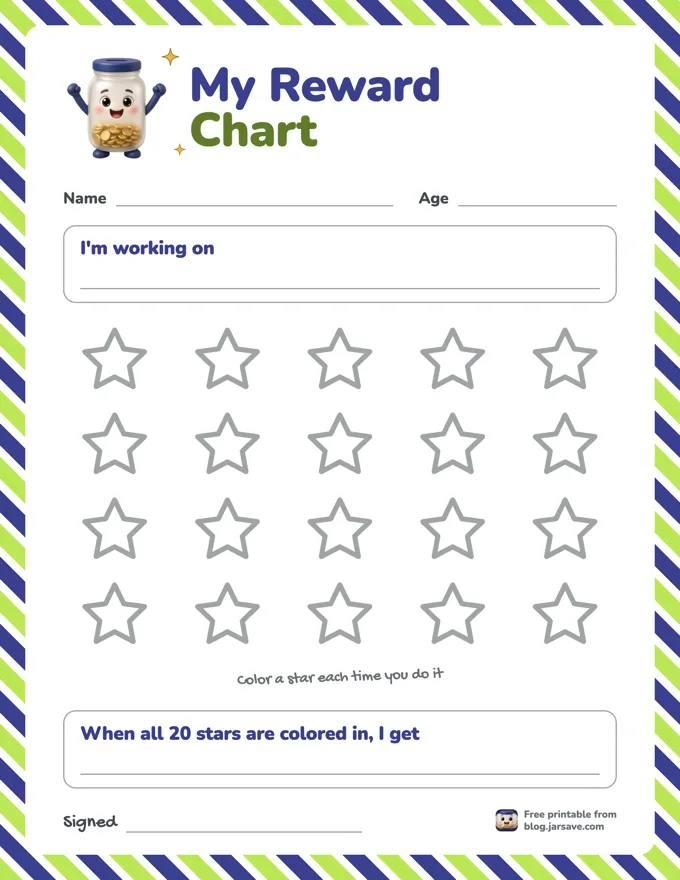
A reward chart is a sheet with one behavior a child is working on and a row of stars, one colored or stuck on each time they do it, until an agreed reward.
Most parents reach for a reward chart for kids the week bedtime or tidying up turns into a daily fight. It makes sense: a row of stars on the fridge is something a small child can see and count.
Raising Children Network, an Australian parenting site, says reward charts work well for children aged 3 to 8. The harder questions are how to set one up so it works, and when to take it down.
How do you make a reward chart for kids that works?
Pick one behavior. Raising Children Network says charts work best for "only one behaviour at a time", and for a short period. The CDC's page for parents of toddlers suggests a couple of behaviors, so treat one or two as the limit.
Write the behavior so a child could check it: "brush teeth before bed", not "be good". The American Academy of Pediatrics (AAP) says paper stars tend to work better for early school-age children, and points or contracts for older ones. The AAP says to avoid penalties, and the CDC puts it plainly: "Never take away rewards your child has earned."
Can rewards make a child lose interest?
Yes, for things they already enjoy. Mark Lepper, David Greene and Richard Nisbett (1973) studied 51 preschoolers at Stanford who liked to draw. One to two weeks after the experiment, those who had been promised a certificate for drawing spent 8.59 percent of their free time drawing, about half as much as children who got no reward.
A review of 128 studies by Edward Deci, Richard Koestner and Richard Ryan (1999) found the same pattern for interesting tasks, and no such effect for dull ones. So a chart suits the thing your child won't do yet, not the hobby they already love.
When should you stop using a reward chart?
Once the behavior has changed and the goal is reached, says Raising Children Network. Phase it out slowly: a star every day, then every two days, then every five, with praise and hugs throughout. Then take a break before starting a chart for something else.
The AAP gives a sign that it is time: your child loses interest, or forgets to ask for their points.
Three things to try at home
- Write the reward before the first star. Tidying up before dinner, for example, earns choosing the bedtime story.
- Give the star right away. The CDC calls a quick reward the most effective way to change a toddler's or preschooler's behavior.
- Name the effort as the star goes on. "You put every block away yourself", then let your child stick it on.
In JarSave, children earn points for minutes of practice and effort, not for every small task, and save them toward wishes a parent approves. The best reward chart is the one your child stops needing.