
Chore chart for kids: a free printable, and the chores that fit each age
The chores the American Academy of Pediatrics lists for ages 5 to 12, what studies found about children who help at home, and a free weekly chart for US Letter and A4.

A chore chart is a weekly table of the household jobs a child does, with a box to tick each day one is done.
A chore chart for kids usually goes up after the third evening of asking for the same thing. Asking every night wears everyone out, and a chart on the fridge does the reminding instead.
It may do more than that. In a US study of 9,971 children, White, DeBoer and Scharf (2019) found that children who did chores more often in kindergarten rated themselves higher on social skills, schoolwork and life satisfaction by third grade. So which chores fit which age, and what should the chart reward?
What chores can kids do at each age?
The American Academy of Pediatrics (AAP) gives a list on its parent site, HealthyChildren.org. At 5 to 7, children can make their bed, set and clear the table, put toys away and sort laundry. At 8 to 10, add vacuuming, helping make dinner and putting away groceries.
At 11 to 12, the list grows to cleaning the kitchen, changing bedsheets, doing laundry and cooking a simple meal with supervision. The AAP adds that "a specific chore chart or checklist can help".
A free printable chore chart for kids
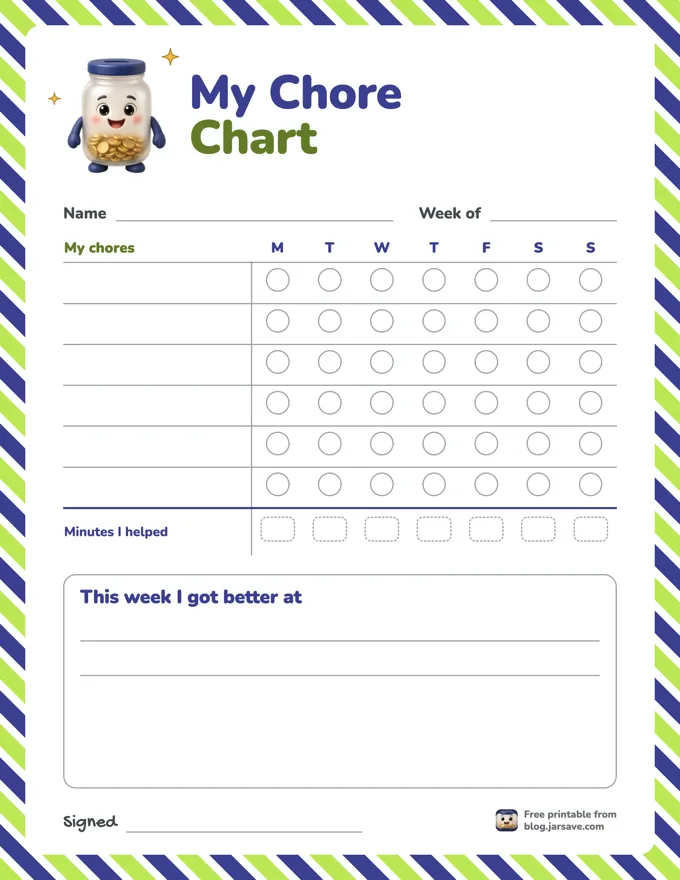
The sheet has six rows for chores, a circle to tick each day, a row for the minutes they helped and a box for what they got better at this week.
Do chores really help children?
Most studies point the same way, but none of them proves cause. White's study only observed families. In an online survey of 207 parents, mostly in Australia, Tepper, Howell and Bennett (2022) found that self-care and family-care chores went with better working memory and inhibition, the skill of stopping before acting. Pet care showed no link.
How chores are asked for seems to matter. In two studies of children aged 9 to 14, Grusec, Goodnow and Cohen (1996) found that only routine family chores, not jobs done on request, went with more concern for others at home, and only in older children. And in a seven-year study of 201 US families, Lam, Greene and McHale (2016) linked housework to more depressive symptoms where children and parents often argued about it.
Three things to try at home
- Pick chores from your child's age band. A 6-year-old can set the table; a 9-year-old can put away the groceries.
- Make them routine, not requests. Write the same chores for the whole week, so the chart asks and you don't have to.
- Count the minutes, not just the ticks. The AAP's advice is to "praise your child's effort in each task, not the outcome", so the chart has a row for minutes helped.
In JarSave, a chore earns points only when a parent makes it a focus area, and it pays for the minutes of effort, not a price per chore. A chart the child fills in on their own is already most of the lesson.